Louisa Clintoff
The Drover's WifeLouisa Clintoff arrives in Australia determined to make more than a home: she wants to establish a women’s journal and give women in the Snowy Mountains a public voice. Her ambitions are tested by the realities of life in Everton, where colonial authority and gendered power leave women such as Molly Johnson with little protection. Louisa’s arc turns on the tension between advocacy and listening: she enters Molly’s story as a reformer with convictions, but learns that solidarity requires making room for the woman whose experience she means to represent.
Identity and ambitions
Louisa is the daughter of Dawn and Reginald Lorens, British publishing proprietors and progressive political writers. Their work, especially their attention to women’s issues, shaped her social conscience and her own desire to write. Her parents had already addressed the dangers faced by women; after Louisa’s sister Hannah died at her husband’s hands, Louisa and her mother also worked to bring the silence around domestic abuse into public view. Louisa carries that commitment into her plans for Australia, hoping to make the concerns of women in the high country visible rather than leaving them unheard.
Her proposed publication, The Dawn, is a monthly women’s journal named for her mother and carrying Hannah’s middle name. Louisa intends it to cover both urgent and everyday subjects: education, childbirth, economics, battered-wife syndrome, poetry, knitting, and cooking. The range reflects an understanding of women’s lives as more than a single political issue. She brings practical tools as well as plans, taking her father’s old mimeograph, wax paper, and bottles of ink on the journey so she can begin publishing in her new home.
Choosing Australia and building a life
Louisa is restless on the night before the family’s departure from London. The move is daunting: she and Nate are travelling halfway around the world to Australia during a global economic depression. Her father calls the decision foolish, while Louisa regards the journey as an adventure and a chance to build a new life. The Victorian government has guaranteed the family’s safe passage, and Nate’s dissatisfaction with his British Army clerical career gives the move a practical purpose as well as an imaginative one.
Nate’s move is also bound up with his health and sense of purpose. Wounded in the South African War, he had been reassigned to clerical work, which he disliked, and had experienced periods of severe melancholia. Louisa helped him recover a sense of possibility through adventurous trips in the countryside during their first years of marriage. Her encouragement leads him to accept a position as the new town’s law officer in the Snowy Mountains, where he can work outside an office and help establish a community. Louisa’s enthusiasm is not merely an accompaniment to his decision: she sees the prospect of a life made through action, and presses him to see it too.
In Everton, their home is a plain, early-Victorian two-bedroom house with a shingled roof, a verandah, and an off-white picket fence. Its open setting near the main road makes it easy to see and reach. The family’s domestic life is part of Louisa’s hoped-for future, but the town is not the quiet, secure place Nate had expected. When lightning ignites a dead tree on the property, Louisa works alone in driving rain to put out the fire with a wet blanket. She then tries to calm a frightened horse in its yard, getting her dress caught on a fence and falling into mud. The episode turns her earlier eagerness for the challenges of country life into a practical test of what those challenges demand, while showing her continuing resolve to handle them.
Family and public work
Louisa and Nate’s marriage rests on affection and mutual encouragement. Their son, Samuel, is central to the future they imagined in Australia: Nate hoped for a safe place for him to grow up, and Louisa’s plans for a journal and engagement with local communities are part of the life she wants to build around the family. In private, their closeness is evident in the ease with which they care for one another. When Nate returns bruised and exhausted after dealing with disorder in town, Louisa embraces him and tends to his bruises; he in turn takes pride in her work and supports her ambitions.
Louisa’s first publication in Everton gives those ambitions a concrete form. She presents Nate with a printed paper produced using the mimeograph and wax paper her father gave her. Proudly, she identifies herself as Everton’s first published female writer and notes that the town was named after Evelyn Edwards. The achievement places her public voice within the town’s history, but it also foreshadows the question that will confront her work: whether a woman who writes about other women can truly represent their experience without listening to them directly.
Her commitment to the family does not shield it from illness or insecurity. When she falls sick with a fever and is unable to care for Samuel, Nate finds her and tends to her. The scene places Louisa’s public ambitions alongside the vulnerable, ordinary demands of motherhood and marriage. Later, as she and Nate are both unwell and their young son is recovering, the case against Molly intensifies around them. Louisa’s attention to Molly is therefore not an abstract campaign detached from family life; it develops within a household that knows the strain of illness and the need for care.
Molly Johnson and the limits of authority
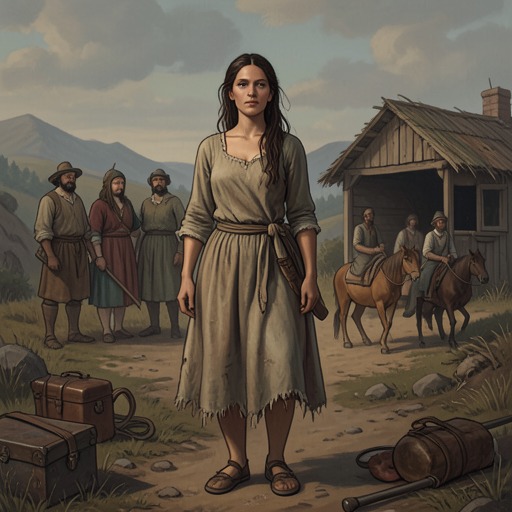
Louisa’s first meeting with Molly follows the Clintoffs’ difficult journey, during which their provisions have been lost in floodwaters. When Nate makes an audacious request, Louisa is appalled by his manner. She asks the woman with the gun to forgive her husband and explains their predicament, introducing the family as travellers who have been on the road for nine and a half weeks from London. Her response combines concern for the immediate situation with an instinct to address Molly respectfully, though the encounter begins under conditions of hardship and mutual caution.
Louisa’s understanding of colonial power deepens through the people she encounters. In a conversation about the wanted Aboriginal man Yadaka, Molly warns that his presence could bring troopers to her doorstep and says she needs him to leave. The danger is not simply a matter of an individual fugitive: the mountain region is described as a place of trouble, and official forces may reach Molly’s property after a delay of two days. Nate discusses checking on Molly’s welfare, but the proposed visit is inseparable from surveillance and the possibility of intervention. Louisa’s position in town gives her comparatively greater freedom than Molly, while Molly’s isolation, race, and exposure to the law make any contact with authorities perilous.
That unequal landscape is made explicit when Yadaka says his only crime is existing while black. The account describes Aboriginal people being blamed, arrested, imprisoned, or driven away, alongside unofficial permission for white people to shoot them on sight. Louisa’s advocacy for women cannot be separated from this colonial setting: Molly’s vulnerability is shaped both by her circumstances as a woman and by racial classification, and the prospect of protection can itself bring danger. Miss Shirley later labels Molly’s children as mixed-blood and pleads for their removal, prompting Judge Eisenmangher to authorize it. The children’s racial identity is turned into grounds for state intervention, making the conflict over women’s rights inseparable from the threat of colonial control over Aboriginal families.
Advocacy, doubt, and listening
As Nate investigates the murder of the Edwards family, the violence in Everton challenges the safe future he and Louisa had imagined. He remembers his wife and son while standing near a dead woman and recognizes how close such violence might come to his own family. Louisa’s work likewise meets the realities of a town where protection for women is uncertain and legal remedies are not readily available. She is committed to legislation for battered wives, but she knows that reform cannot arrive in time to help Molly.
Louisa and Nate disagree over Molly’s suspected killing of her husband. Nate believes evidence at the Johnson property points to a concealed death, while Louisa argues that a mother may reach a limit when her children are threatened and she has no one to turn to for help. She does not claim that death is desirable; she asks Nate to consider the circumstances that could drive a woman to defend her children. Their conflict is not a simple division between law and compassion. Nate is bound to uphold the law as Everton’s peacekeeper, while Louisa judges the law against the absence of meaningful protection for abused women. Each understands that the other is struggling with a different obligation, and that disagreement strains their marriage.
During the hearing, Miss Shirley presents Molly’s mixed heritage as an explanation for hatred and revenge, and the Crown’s closing argument links her ancestry to her actions. The jury is all male. Nate believes the proceeding is biased, but sees no way to change its outcome; Danny, the only witness to Molly’s truth, is missing. Louisa recognizes that her campaign for legislation will not save Molly from the court’s judgment. Her position in the town gives her a platform, but that platform has not made the legal system answerable to the woman it is judging.
Before the execution, Louisa brings Molly hot food, a musk-pink dress, and the blood-red shoes she wore to a ball in Melbourne held in her and Nate’s honour. Their relationship is still unsettled, and Louisa initially approaches as an advocate who wants to secure practical help for Molly’s children. She urges Molly to tell her or Nate where the children are, arguing that Danny could help Molly’s case. Molly asks what would happen if he could not; Louisa has no answer. The exchange exposes the limits of her ability to promise safety, even when her concern is genuine.
The clearest challenge to Louisa comes when Molly tells her that she writes from the outside. Louisa explains that she has been trying to give voice to an issue silenced for too long, drawing on her own sister’s death at the hands of her husband. Molly answers that she could hear only Louisa. The rebuke separates good intentions from representation: Louisa has made women’s suffering part of a public cause, but her writing has not yet allowed Molly’s own account to come through. Louisa accepts the point rather than defending herself. She then asks Molly to tell her story, and Molly corrects the formality by giving her first name. The change from “Missus Johnson” to “Molly” marks a small but meaningful shift from speaking about a woman to listening to her.
Protest and narrative significance
At Molly’s execution, Louisa joins two other women in removing their capes to reveal aprons marked with a demand to hear the condemned woman and legislate women’s rights. They join hands and step forward as some men respond with disapproval. Nate is moved by Louisa’s courage, yet remains in his appointed role as the town’s law officer. Their positions converge and divide at once: he sees her protest as brave, but cannot abandon the institutional duty that has helped carry Molly toward execution; she acts publicly against the power that duty represents.
Louisa’s story is therefore not a straightforward account of a reformer succeeding. She establishes herself as Everton’s first published female writer, brings a women’s-rights campaign into public view, and stands beside Molly when the legal process offers no timely remedy. Yet Molly’s criticism reveals that advocacy can reproduce a hierarchy when the reformer’s voice overwhelms the person she means to support. Louisa’s willingness to hear that criticism and ask for Molly’s story marks a change in her practice, even as the execution shows the limits of what listening and protest can prevent. Her journal remains a hoped-for means of public speech; the final demand of the scene is that women’s voices be heard not only through a writer, but in their own words.